






How Line Shopping Puts More Money Back in Your Pocket
Two bettors pick the same team. Both win. One collects more money than the other, not because they were smarter, not because they had better information, but because they checked a second sportsbook before placing their bet.
That is line shopping. It is the single most straightforward edge available to any sports bettor on Jackpot.bet, and it costs nothing but a few seconds of comparison before locking in a wager.
What Is Line Shopping?
Line shopping is the practice of comparing odds across multiple sportsbooks before placing a bet to find the most favorable price for the same wager.
The bet is identical, same team, same market, same stake, but the return varies depending on where you place it.
The concept is no different from checking two retailers before buying the same product. The only difference is that in sports betting, the price gap between sportsbooks is usually small on any single bet.
The reason it matters is volume, across a full season of regular betting, those small gaps compound into a meaningful difference in total return.
Why Line Shopping Matters More Than Most Bettors Realize
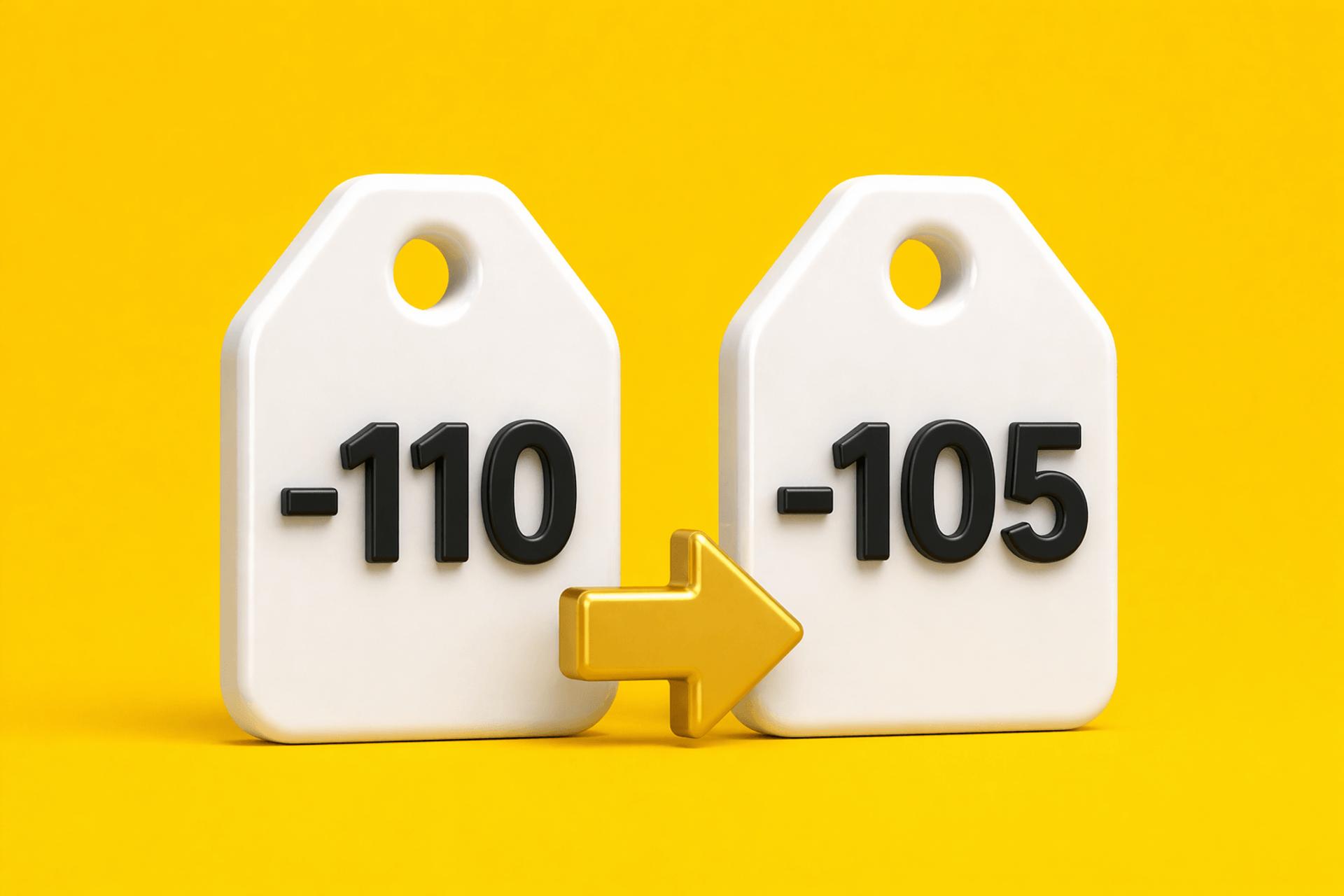
The gap between -110 and -105 looks negligible at first glance. On a single $100 bet it is worth less than $5. But the math changes significantly at scale.
At -110, you risk $110 to win $100. At -105, you risk $105 to win $100. The difference per bet is $5 in vig, money that goes to the sportsbook rather than staying in your pocket.
|
Bets Placed |
Always at -110 |
Always at -105 |
Difference |
|
100 bets |
$1,050 vig paid |
$500 vig paid |
$550 |
|
200 bets |
$2,100 vig paid |
$1,000 vig paid |
$1,100 |
|
500 bets |
$5,250 vig paid |
$2,500 vig paid |
$2,750 |
A bettor placing 200 bets per season at $100 each saves over $1,100 just by consistently taking -105 over -110, without changing a single handicapping decision.
That is not a marginal improvement. For most recreational bettors, it is the difference between a losing year and a breakeven one.
The relationship between line shopping and vig is direct, every time you find a better price, you are reducing the sportsbook's margin on that bet.
The lower the vig you pay across your betting, the lower the win rate you need to break even long-term.
How Line Shopping Works in Practice
The process is straightforward and takes seconds once it becomes habitual.
Step 1: Identify the bet you want to place and the market you want to bet on.
Step 2: Check the current odds on that market at Jackpot.bet and note the price.
Step 3: Compare that price against at least one other reference point, a second sportsbook, an odds aggregator, or a comparison tool.
Step 4: Place the bet at whichever book offers the best available number before the line moves.
Two things can differ between sportsbooks and both are worth shopping:
Odds shopping, the spread or total is identical but the price attached differs. -3 at -110 vs -3 at -105 is odds shopping. Same position, less vig.
Line shopping, the number itself differs. -3 at one book vs -3.5 at another. For spread and total bettors this is often more valuable than odds shopping because a half-point can flip the result of a bet entirely.
Line Shopping Across Different Bet Types
Not every bet type rewards line shopping equally, here is where the real differences show up.
Moneylines
The simplest version of line shopping. Find the sportsbook paying the most for your pick. A +130 vs +120 difference on a $100 winning bet is $10 found for zero additional effort. On underdogs especially, where the juice varies more widely between books, moneyline shopping consistently produces the largest single-bet differences.
Spreads and Totals
Two variables to compare, the number and the odds. Getting -3 instead of -3.5 on an NFL spread can turn a loss into a push. Getting -108 instead of -110 on the same number saves money without changing the position at all. Always check both dimensions before placing.
Parlays
Vig compounds across every leg of a parlay. A slight improvement on each individual leg multiplies across the whole ticket.
A two-leg parlay where both legs move from -110 to -105 increases the net payout meaningfully, and the effect grows with every leg added.
Futures and Outrights
Futures markets carry the widest vig of any bet type, often 15–30% across the full field. The variance between sportsbooks on the same futures market is also the largest of any bet type.
Shopping a 32-team outright market across three books and taking the best number for your pick can cut the effective vig substantially compared to betting blind at a single book.
The Half-Point and Full-Point Edge
One of the most underrated aspects of line shopping is what a single half-point is worth on key numbers in specific sports.
In NFL betting, more games end with a margin of exactly 3 or exactly 7 than any other number. Moving from -3.5 to -3 on a spread is not just a half-point improvement, it is the difference between losing and pushing on one of the most common final margins in the sport.
The same logic applies to -7 and -7.5. Sharp bettors will accept worse odds to buy off a key number because the value of that half-point exceeds the cost of moving the price.
In NBA betting, margins of 5 and 7 function similarly. In soccer, the equivalent exists at -0.5 and +0.5 on Asian lines where the draw is the critical outcome.
When line shopping, a half-point difference on a key number is worth far more than the odds difference alone suggests, and it only appears if you check more than one book.
Common Mistakes When Line Shopping
Most bettors shop lines occasionally, these are the habits that quietly cancel out the edge entirely.
Checking too many books and missing the window
Lines move constantly, especially close to game time. Spending ten minutes comparing eight sportsbooks while a sharp line move closes the gap defeats the purpose. Pick two or three reliable reference points and move decisively.
Assuming all books price independently
Many sportsbooks share technology providers and their lines track closely. Comparing two books running the same odds feed produces no useful information. Focus on books known to price markets differently.
Only shopping spreads and ignoring props
Player props and alternative lines carry wider vig and greater variance between books than standard spread markets. Some of the largest line shopping edges available sit in prop markets where pricing is less efficient.
Treating line shopping as optional
Every bet placed without checking an alternative price is a bet where you may be paying more vig than necessary.
Making it a habit on every wager, not just big ones, is what separates disciplined bettors from recreational ones.
Conclusion
Line shopping does not require any handicapping skill, any additional research, or any change in the bets you were already planning to make.
It requires checking the price before you pay it. Over a season of regular betting that habit, applied consistently and without exception, compounds into one of the most reliable sources of additional return available to any bettor.
The picks drive the wins and losses. The line shopping determines how much you collect when you are right.
Frequently Asked Questions
What is line shopping in sports betting?
Line shopping is comparing the odds offered by multiple sportsbooks on the same bet before placing it, with the goal of finding the most favorable price. The wager is identical, the return differs based on where you place it.
How much money does line shopping actually save?
It depends on volume. The difference between -110 and -105 on a single $100 bet is around $5. Across 200 bets in a season at that stake level it exceeds $1,100. The more bets placed and the larger the stakes, the more significant the cumulative impact.
Does line shopping work for all bet types?
Yes, but the value varies. Moneylines and futures tend to show the widest odds variance between books, making them the most rewarding to shop. Spreads and totals benefit most from shopping the number itself rather than just the price. Props sit somewhere in between.
How many sportsbooks do I need to line shop effectively?
Two or three is enough for most bettors. Having accounts at books that price markets independently of each other produces more useful comparisons than having ten accounts where most track the same line. Quality of comparison matters more than quantity of books checked.